
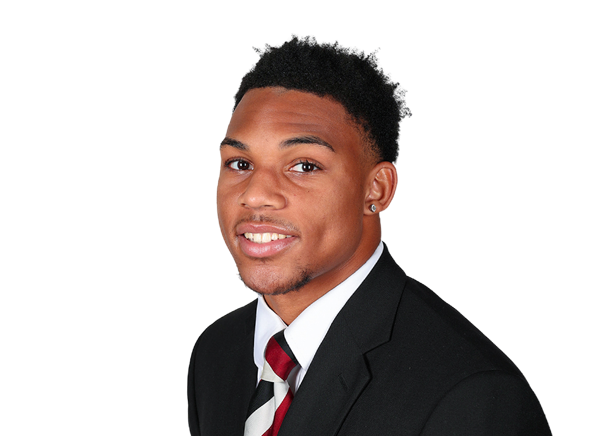
Kosci Barnes
 South Carolina
Freshman
South Carolina
Freshman
Bio
Recruiting
Scouting Report
Kosci Barnes is a 4-star Cornerback from Greensboro, NC (Grimsley) in the 2026 class. Ranked No. 242 nationally. Composite rating: 0.9159. Committed to University of South Carolina.
Physical Profile
Listed at 6-2, 190 lbs. Taller than 79% and heavier than 93% of 2026 Cornerback prospects in the SEC Scouts database (204 with a listed size).
Play Style
Barnes is an aggressive press corner who uses his length to disrupt receivers at the line and then stays in phase downfield. He plays the ball like a receiver: he looks for it, high-points it and finishes interceptions instead of just breaking passes up. Against the run he comes downhill and tackles without hesitation, which is unusual for a tall corner and explains his 9 TFL as a senior. His game is most comfortable in press-man and Cover 3 rotations where he can keep the play in front of him and use his size. He is less refined when asked to play patient off-man with clean backpedal transitions.
Strengths
- Length at the catch point: at 6-2 with a long frame he can contest over the top and play through the receiver's hands. His senior line of 4 INT and 5 PBU shows it, and he turned that into an interception immediately at the SEC level.
- Ball skills from his receiver background: he started as a WR before moving to corner, and he tracks the ball in the air and attacks it like a pass-catcher rather than just breaking it up.
- Physical tackler who plays downhill: 54 tackles (44 solo), 9 TFL and a sack as a senior is heavy run-support production for a corner. It shows he is willing to fill alleys and handle perimeter screens, which also makes him viable at nickel.
- Proven against top competition: he started on back-to-back North Carolina state champions (the 7A final was a 24-14 win over Clayton) and held off a final six of South Carolina, Miami, Kentucky, Rutgers, North Carolina and Mississippi State across 20+ offers.
Areas to Improve
- Technique maturity: he has a short history on defense, so his footwork in off-man and his pattern-matching discipline in quarters are still developing. Veteran SEC receivers will test his eye discipline on double moves and stems.
- Hip fluidity and recovery speed at his new weight: at 209 lb he needs to prove he can still flip his hips and recover against sudden slot and speed receivers. Otherwise he could project inside to nickel or even to safety instead of staying an outside corner.
- Special-teams and rotational reps: as a true freshman he needs to earn snaps beyond garbage time (his debut came in the 4th quarter of a 57-0 game) by showing consistency in the base defense and on coverage units.
College Projection
2026: rotational depth corner and special-teams contributor (roster No. 28). An early interception keeps him in the staff's plans, and the early-enrollee spring gives him a real chance to push into the two-deep by midseason. 2027: a realistic competitor for a starting boundary corner job, especially if SEC attrition or the portal opens a spot. Pre-rankings of 94 in-house on 247 and 0.9159 Composite fit a multi-year starter, which is what he projects as by year two or three. His floor if his speed doesn't hold up at 210+ is a big nickel or a move to safety, not a bench player.
NFL Outlook
Legitimate Day 2–Day 3 draft upside if he stays at outside corner. NFL teams prize 6-2, 205+ lb corners with ball production, and his tackling adds value in press and zone-heavy schemes. The main draft variable is timed speed: a 4.4x forty at his size would move him up boards, while a 4.5+ would likely steer him toward safety or big-nickel evaluations. Three productive SEC seasons are the minimum to be draft-eligible and ranked.
Best Fit
A press-heavy Cover 3 or Cover 1 scheme that lets him play near the line on the boundary and use his length, which is what he has at South Carolina. He would be a weaker fit in a spot-drop, off-coverage quarters system where his still-developing backpedal would be exposed every down.
Player Comparison
Jack entered UCLA as a 4-star prospect with similar size (6'1", 192 lbs) and positional flexibility, initially recruited as a safety before moving to linebacker. Like Barnes, he had elite athleticism and versatility that allowed coaches to maximize his impact across multiple positions, demonstrating the type of scheme-diverse skill set that makes prospects valuable despite unclear positional fit.
Current Team
University of South Carolina