
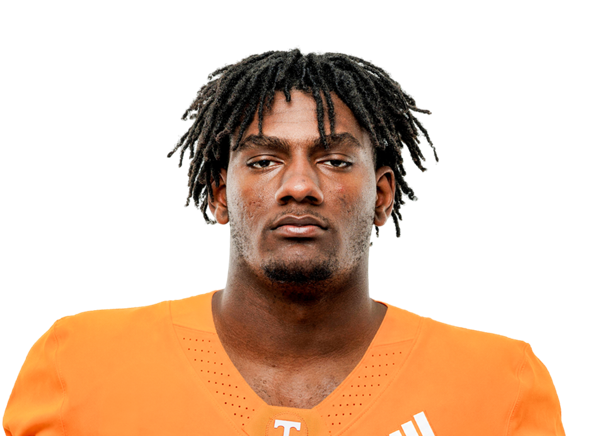
Darryl Rivers
 Tennessee
Freshman
Tennessee
Freshman
Bio
Recruiting
Scouting Report
Darryl Rivers is a 3-star Defensive Line from Powder Springs, GA (McEachern) in the 2026 class. Ranked No. 554 nationally, No. 48 at DL, No. 50 in GA. Composite rating: 0.8867. Committed to University of Tennessee since July 3, 2025.
Physical Profile
Listed at 6-4, 270 lbs. Taller than 67% and heavier than 42% of 2026 Defensive Line prospects in the SEC Scouts database (227 with a listed size).
Play Style
Rivers is a length-first lineman who plays with his hands. His best snaps come when he gets his arms extended first, stays clean, and then either sheds to make the tackle or turns his angle into the backfield. He did most of his work from the interior but looked comfortable kicked out to end. There his size lets him set the edge against tight ends and slower tackles, but he doesn't threaten the corner with speed. He plays hard and chases plays down the line, which helped his tackle totals. His rushes are mostly bull-rush and long-arm moves, with occasional hand swipes. He's more of a pocket-collapser and run-stuffer who tips passes than a pure sack artist.
Strengths
- Length and frame: 35-inch arms on a 6-5 body that already carries close to 290 pounds. Garner's staff and outside analysts call it a college-ready frame, and it's the main reason Tennessee took him over a higher-ranked option.
- Disruptive production: his junior Hudl tape credits him with 60 tackles, 15 tackles for loss, 5 sacks and 2 pass breakups. That's a lot of backfield plays for someone who lined up mostly at defensive tackle and drew interior double teams.
- Alignment versatility: he played 5-technique, 4i and edge at McEachern, so he has already handled different run fits and rush angles. That makes the switch to a 3-technique or big end in Tennessee's front much easier.
- Steady improvement: he played his best football late in his junior year, then backed it up with strong senior tape. He earned All-Region 3-6A first-team defense for a McEachern team that went 10-1 (7-0 in region).
Areas to Improve
- Pad level and anchor: like most tall interior linemen, he plays too upright when he's tired. He needs to sink his hips and hold up against double teams before Tennessee can trust him on early downs.
- Pass-rush plan: his sacks came mostly from length and effort, not a set sequence of moves. He needs a go-to counter, like a long-arm into a club/rip or a push-pull, so he can win against SEC guards who can stop his first move.
- Strength gains: he's already near 290, but his lower-body power and core strength have to catch up to his weight. That usually takes a full redshirt year of college strength work.
College Projection
Expect a redshirt in 2026 behind an older group, with practice reps alongside fellow freshmen Dereon Albert, Nuk Simmons and JJ Finch. He can play up to four games without losing the redshirt. Garner has a long record of developing long, mid-ranked Georgia linemen, which fits his profile. A realistic path is a rotation role at 3-technique or big end in 2027 at around 295-300 pounds, a push for a starting job by 2028 (his redshirt sophomore year), and a chance to be a multi-year starter if his anchor develops. His floor is a dependable 15-25 snap rotation player who stuffs the run and gets hands on passes.
Best Fit
He fits a multiple four-man front that asks its interior linemen to attack and use their length, which is what Tennessee runs under Garner. The ideal setup lets him play a 3-technique or 4i on early downs and slide out to a big end against heavy personnel. He's also a good fit for a program with a patient strength staff, since the main thing between him and a starting job is two years of physical development. He would be a poor fit in a two-gap 3-4 nose role or a speed-rush-only edge role.
Current Team
University of Tennessee