
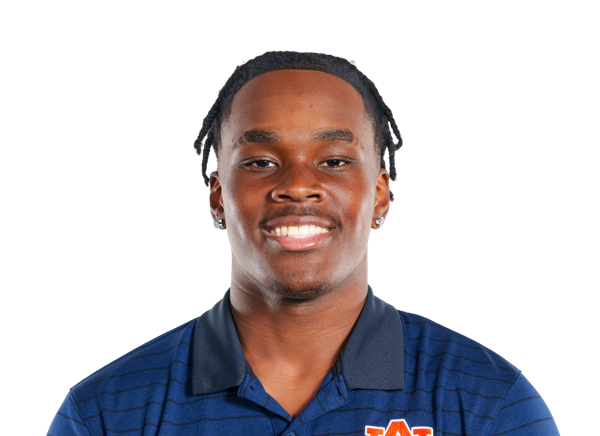
Damonte Tabb
 Auburn
Freshman
Auburn
Freshman
Bio
Recruiting
Scouting Report
Damonte Tabb is a 3-star Safety from Alabaster, AL (Thompson) in the 2026 class. Ranked No. 665 nationally, No. 28 at S, No. 22 in AL. Composite rating: 0.8822. Committed to Auburn University since December 4, 2025.
Physical Profile
Listed at 6-2, 180 lbs. Taller than 74% and heavier than 27% of 2026 Safety prospects in the SEC Scouts database (200 with a listed size).
Play Style
Tabb is an instinctive, ball-first safety who reads the quarterback, breaks on throws and finishes at the catch point. He is most comfortable playing from depth with his eyes in the backfield, where his length lets him reach throws other safeties can't. He tracks deep balls well near the sideline and shows natural hands and the boundary awareness to finish catches inbounds. Against the run he will fill and tackle, as his 78 tackles show, but he is more of a coverage-first player than an enforcer. His tape shows a playmaker who changes games with turnovers rather than a thumper who sets the physical tone.
Strengths
- Elite ball production: 11 interceptions and 11 pass breakups as a senior. That is 22 passes defended against 7A competition, which reflects real ball skills and route anticipation, not luck.
- Plays big in big games: three interceptions in the 7A semifinal against Central-Phenix City, then his 10th of the season early in the fourth quarter of Thompson's 48-10 state-title win over Opelika.
- Length and catch radius: at 6-3 he can play the ball at its highest point and contest throws that shorter safeties can't reach, which suits deep-half and deep-middle duties.
- Willing in run support: 78 tackles and 4 tackles for loss show he will come downhill and isn't only a centerfielder.
- Developed in an elite program: Thompson has played in eight straight state championship games and won six titles in seven years, so he is used to high-level coaching, practice competition and big-game settings.
Areas to Improve
- Add functional mass and play strength: at 195 he will struggle to take on SEC pulling guards and 220-pound backs in the alley, and tackling through contact at the college level depends on getting stronger.
- Eye discipline and change-of-direction in man coverage: tall safeties often take false steps when matched up with quick slots. He has to show he can sink his hips and stay square in quarters and match-man coverage, not just make plays in front of him from depth.
- Tackling angles in space: ball hawks tend to arrive aggressively, and the speed of SEC ball carriers will punish poor pursuit angles more than high school did.
College Projection
Year 1 (2026): he is likely to redshirt or play special teams for an Auburn staff in its first season under Alex Golesh, using the four-game redshirt allowance to get early snaps while he builds strength. Year 2: competes for a rotational spot at free safety or in the dime package once he's in the 205-210 range. Years 3-4: realistic ceiling is a starting free safety or deep-half safety whose takeaway ability outplays his recruiting ranking. Floor is a reliable special teams player and backup in the secondary. Because Auburn took him as a late addition rather than recruiting him all cycle, the staff will likely ask him to develop rather than play right away.
Best Fit
A program that plays two-high or quarters coverage and lets its safeties read the quarterback and break on the ball, rather than one that asks them to play man-to-man on slot receivers or act as an extra linebacker. He also needs a strong strength-and-conditioning program to add mass without losing range. Auburn, an in-state SEC program near home with a new staff evaluating everyone fresh, gives him a fair chance to earn snaps. His best role is as the deep, ball-hawking free safety, ideally next to a more physical strong safety who handles box duties while he develops.
Current Team
Auburn University