
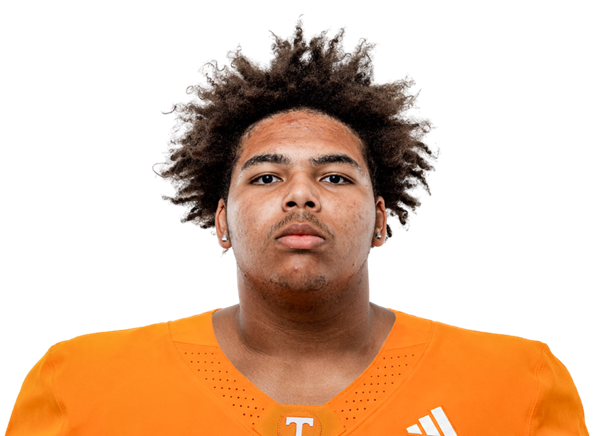
Jeremy George-El
 Tennessee
Freshman
Tennessee
Freshman
Bio
Recruiting
Scouting Report
Jeremy George-El is a 6-4, 310-to-325-pound interior offensive lineman from Knoxville Catholic who signed with Tennessee on February 4, 2026, after the staff upgraded him from a preferred walk-on target to a scholarship offer in mid-January. A Quebec native who moved to the U.S. before his junior year, he earned Division II-AAA All-State honors as a senior and led the Fighting Irish in pancake blocks while helping them reach the TSSAA Division II state semifinals. He profiles as a developmental power guard with a mass-first frame and only two seasons of American high school football on his resume.
Physical Profile
George-El carries a thick, top-heavy build at roughly 6-4 and 310-325 pounds, which is already SEC-guard mass as a freshman. He was a shot put (40-11) and discus (105-8) thrower in track, and those marks point to functional upper-body power and hip rotation rather than elite explosion; the discus number in particular is modest for a lineman of his size. His height is on the upper edge for guard, giving him length to fit hands and cover ground on down blocks, but the weight fluctuation between 310 and 325 reported across sources suggests his body composition is still unsettled. The frame belongs inside; he does not have the foot quickness or arc-protection range to be considered at tackle.
Play Style
George-El is a mauler who plays with a low, wide base and wins through mass and leverage rather than finesse. On film he is at his best on the front side of gap and duo runs, where he can drive a nose tackle or three-technique off the line and finish through the whistle, which is where his pancake production comes from. He shows a competitive temperament and a willingness to bury defenders, but his footwork is still mechanical, and he can be late resetting after the initial punch. In pass protection he leans on his anchor and rarely gets walked back, but quicker rushers can get him reaching and turning his shoulders.
Strengths
- Ready-made size and play strength: at 310-325 pounds he can anchor against SEC interior rushers without needing a two-year weight-room build, and his eight team-leading pancake blocks show he finishes when he gets his hands on a defender.
- Left guard down-blocking and double-team displacement: his senior Hudl film at left guard shows him generating vertical push on combo blocks, which is exactly the trait Glen Elarbee's Tennessee scheme asks of interior linemen in its wide-zone and duo run game.
- Rapid development trajectory: he went from a Quebec transplant with no American football background to All-State in two seasons, which indicates strong coachability and a learning curve that has not flattened yet.
Areas to Improve
- Pass-protection technique and hand independence: his tape is run-dominant, and against SEC three-technique quickness he will need to shorten his set, keep his elbows tight, and stop leaning on his mass to win reps.
- Lateral agility and second-level range: the modest discus mark and heavy frame suggest limited change-of-direction, so reaching linebackers on zone plays and recovering against inside counters will be a focus.
- Conditioning and body composition: settling into a lean 315-320 with better stamina will matter more than adding weight, given he is already at the top of the guard range.
College Projection
Tennessee's staff signed him late as a depth-and-development piece behind a class headlined by five-star Gabriel Osenda and four-star Kamari Blair, and local coverage projects him as a backup who redshirts in 2026. The realistic timeline is a redshirt year, scout-team and special-teams work in 2027, and a push for a two-deep role at guard in 2028 as a redshirt sophomore. His ceiling is a multi-year SEC starting guard at 320-plus pounds if his pass-set technique catches up to his run-blocking; his floor is a reliable rotational interior backup who never leaves Knoxville.
Best Fit
A run-heavy, gap-and-duo-oriented offense that lets him play downhill from a guard alignment and does not ask him to reach-block or pull in space. Tennessee's up-tempo attack under Josh Heupel puts more stress on conditioning and lateral zone footwork than his profile prefers, so his development will hinge on Elarbee's ability to refine his feet while preserving the raw power that made the staff upgrade him from walk-on to scholarship.
Current Team
University of Tennessee