
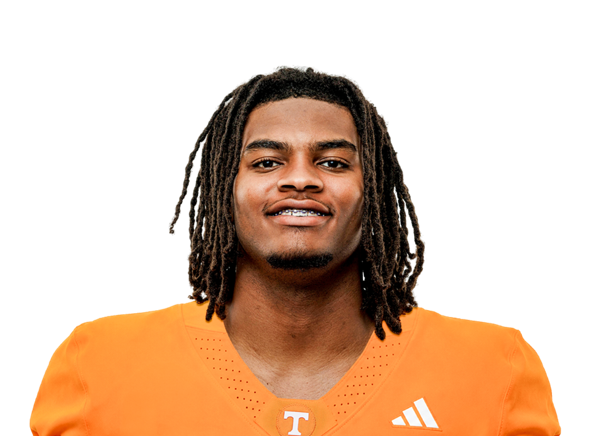
Breeze Carter
 Tennessee
Freshman
Tennessee
Freshman
Bio
Recruiting
Scouting Report
Breeze Carter is a 4-star Edge Rusher from Douglasville, GA (Douglas County) in the 2026 class. Ranked No. 183 nationally. Composite rating: 0.9263. Committed to University of Tennessee since July 26, 2026.
Physical Profile
Listed at 6-3, 255 lbs. Taller than 21% and heavier than 91% of 2026 Edge Rusher prospects in the SEC Scouts database (169 with a listed size).
Play Style
In high school he played as a hand-in-the-dirt or stand-up edge who attacked downhill. He won with first-step quickness, then converted that speed into power through the tackle's chest. He plays with good balance and body control, stays square against the run, and shows the awareness to find the ball carrier and finish. His sack total came mostly from effort and power: collapsing the pocket and chasing down quarterbacks, not dipping under tackles with elite bend. His motor and physical style suit a rotational role now and a starting power-edge role later.
Strengths
- Proven production against strong Georgia competition. The services disagree on his senior line: 247/ESPN have 83 tackles, 23 TFL and 18 sacks, while Tennessee's bio lists 12 sacks. His three-year totals are 84-13-15 as a sophomore, 57-15-11 as a junior and 83-23-18 as a senior (247/ESPN), for 44 career sacks and 51 career TFL. He was a MaxPreps second-team All-American.
- Power-based rush plan backed by a quick first step. ESPN credits an explosive get-off, and 247 describes him as a power rusher who wins through balance and leverage rather than pure bend.
- Firm at the point of attack. ESPN notes good point-of-attack play, and his added college weight (about 255-268 lbs) makes him a credible run defender on early downs.
- Scheme flexibility. His thickness and lateral quickness let him play a stand-up LEO, a hand-down DE, or slide inside on passing downs, which 247 notes as 'alignment flexibility.'
Areas to Improve
- Rush variety. 247 calls him 'primarily one-speed.' He needs a dependable counter move, such as an inside spin or a long-arm into a club, plus better tempo changes so SEC tackles can't simply sit on the power rush.
- Bend and flexibility around the corner. Without elite length, he has to improve ankle flexion and hip turn to beat tackles on the outside arc. Otherwise he risks becoming a run-first, rotational edge.
- Handling the added weight. He has gone from about 245 to 255-268 lbs, and that mass needs to become functional strength without costing him the first-step quickness that made him effective in high school.
- Snap-by-snap consistency and stamina against SEC tackles. He is in his first college season and has played limited defensive snaps so far.
College Projection
He enrolled at Tennessee in January 2026 and wears No. 95/98 (sources differ). He was listed as a third-team DE on the Week 1 depth chart against Furman, sharing that spot with classmate Hezekiah Harris. As of mid-September 2026 he had played 2 games and 6 defensive snaps, mostly contributing on special teams. Against Kennesaw State he played 5 snaps and registered 1 QB hurry. The two services project different timelines: 247 says he 'will likely need a developmental year or two,' while ESPN says he can contribute right away. A realistic path is special teams and a few spot rushes in 2026, probably a redshirt under the four-game rule. From there, a rotational pass-rush role in 2027 and a push for a starting job as a third-year player in 2028, once his rush plan is more developed.
NFL Outlook
He projects as a Day 3 to mid-round prospect, with room to rise if he develops a counter rush. The 247 Composite ranking and his height/length point to a solid college starter, and 247 compares him to Nebraska's Cameron Lenhardt. ESPN's No. 57 ranking and his high school production point to a higher ceiling. NFL teams will likely see him as a 4-3 power end or a base-downs edge in an odd front. His draft stock depends on proving he can win in more than one way against SEC tackles by his third or fourth season.
Best Fit
A multiple-front defense that uses a LEO/power-end role and rotates its edge players heavily. Tennessee under Josh Heupel and DC Tim Banks fits that description. It lets him play early downs against the run from a 5-technique or LEO spot, rush in sub packages without wearing down, and develop behind veterans like Tyree Weathersby and Carson Gentle. He is less suited to a wide-9 scheme built around length and speed off the edge.
Current Team
University of Tennessee