
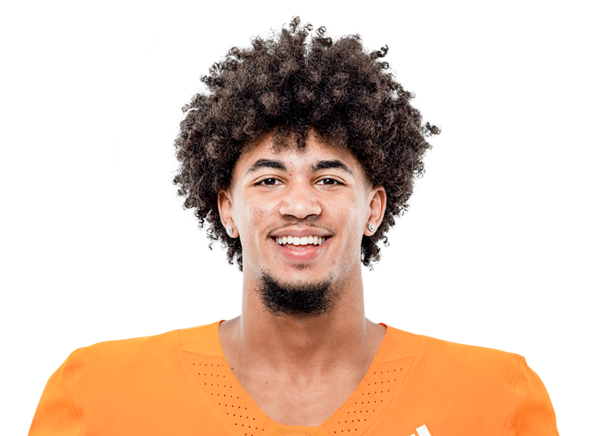
Brayden Carroll
 Tennessee
Freshman
Tennessee
Freshman
Bio
Recruiting
Scouting Report
Brayden Carroll is a 3-star Wide Receiver from Cleveland, TN (Bradley Central) in the 2026 class. Ranked No. 2533 nationally. Composite rating: 0.8400. Committed to University of Tennessee.
Physical Profile
Listed at 6-2, 190 lbs. Taller than 59% and heavier than 72% of 2026 Wide Receiver prospects in the SEC Scouts database (329 with a listed size).
Play Style
His all-purpose and touchdown numbers point to a do-everything weapon that Bradley Central used at receiver, in the screen and jet-motion game, and near the goal line. He fits the bigger 'X' or boundary receiver mold. He probably wins with body position, hands and size on slants, fades and back-shoulder throws more than with pure acceleration. His scoring total suggests he finishes well and holds onto the ball in traffic. Public game-film breakdowns are limited (his Hudl profile exists, but there are no detailed third-party evaluations), so this description comes from his production profile rather than verified film grades.
Strengths
- Production as a scorer: 22 total touchdowns as a senior shows he finished drives and was a featured red-zone option on a Bradley Central team that went 8-4 and reached the TSSAA Class 6A second round
- Versatility: 1,240 all-purpose yards (not just receiving) means Bradley Central found several ways to get him the ball, which points to some run-after-catch ability and possible special-teams value
- Frame and catch radius: at 6-2/190 per 247 he can win on back-shoulder throws, contested catches and fades, the routes that let a bigger receiver play above his speed
- Desirable profile beyond Tennessee: offers from Army, Navy and Yale point to strong academics and discipline, and the Cincinnati and App State offers show FBS staffs valued his tape
Areas to Improve
- Play speed and separation: his 3-star, 0.84 grade and mostly Group of 5/FCS offer list suggest he did not show the burst to separate easily, so route detail (stem pacing, breaks at the top of the route, releases against press) will decide whether he sees the field
- Strength and play-time readiness: he needs to add 10-15 pounds of functional mass to beat SEC press coverage and hold up as a blocker, and as a walk-on he has to earn reps on special teams and the scout team first
- Consistency over one season: most of his production came from a single senior year after the transfer, so he needs to show it holds up week to week against stronger competition
College Projection
He is a developmental preferred walk-on. Expect a redshirt in 2026, with time spent on the scout team learning Josh Heupel's tempo-based offense, which uses wide receiver splits. His realistic route to the field is special teams (coverage units, possibly returns given his all-purpose background) in Years 2-3. He could become a rotational boundary receiver by Year 3 or 4 if he gains strength and separation ability. Earning a scholarship is a realistic medium-term goal, since in-state PWOs who contribute on special teams often get put on scholarship. He is unlikely to be a featured receiver at Tennessee, but he can be a dependable depth piece and special-teams player.
Best Fit
Tennessee's wide-split, vertical spread attacks the boundary and rewards bigger receivers who win the catch point, so it suits his frame, as long as he develops enough route detail. His natural fit outside the SEC would have been a ball-control or option-based Group of 5 or service academy offense, where his size, blocking upside and discipline would have earned early playing time (Army, Navy and App State all offered). At Tennessee he fits best as a boundary 'X' and special-teams player who develops slowly while redshirting.
Current Team
University of Tennessee