
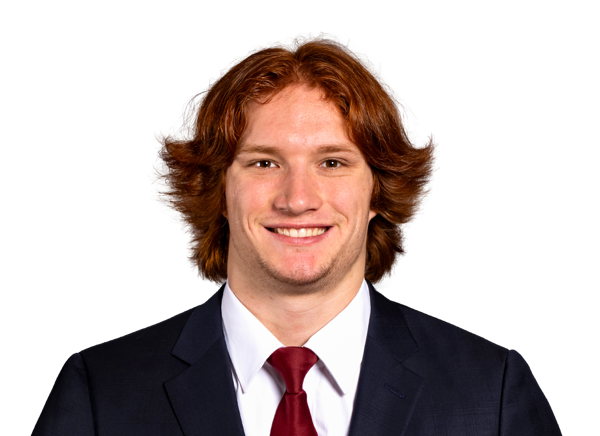
Jacob Curry
 Oklahoma
Freshman
Oklahoma
Freshman
Bio
Recruiting
Scouting Report
Jacob Curry is a 4-star Linebacker from Ponte Vedra Beach, FL (Nease) in the 2026 class. Ranked No. 378 nationally, No. 16 at LB, No. 30 in FL. Composite rating: 0.8979. Committed to University of Oklahoma since October 9, 2025.
Physical Profile
Listed at 6-1, 208 lbs. Taller than 19% and heavier than 40% of 2026 Linebacker prospects in the SEC Scouts database (207 with a listed size).
Play Style
On film Curry is an aggressive, downhill defender who does most of his damage in space and near the line of scrimmage. Nease used him in several ways: reading run/pass from the second level, walking down over the slot, and pressuring off the edge. That usage explains both the double-digit TFL total and the seven PBUs. He trusts his reads and plays fast, with a tendency to beat blockers to the spot instead of taking them on squarely. When the ball goes to the perimeter he is a reliable open-field tackler and pursues well from the backside. His style fits the modern trend toward lighter, faster linebackers: he looks more like a big safety playing in the box than a traditional thumper.
Strengths
- He produced all over the field as a junior: 101 tackles, 12 TFL, 8 sacks, 11 QB hurries, 7 PBUs, 2 forced fumbles and a fumble recovery for an undefeated regular-season Nease team. Few players post that range across tackling, pass rush and coverage in one season.
- He can play several spots. Colleges recruited him as a safety and as a linebacker, and Oklahoma specifically sees him as a fit at its 'Cheetah' spot, a nickel/overhang/SAM hybrid that has to set the edge, blitz and cover in the same series.
- He is an effective blitzer from depth. Eight sacks and 11 hurries from an off-ball or overhang alignment show good timing, the ability to find open lanes, and the closing burst to finish at the quarterback.
- He has ball skills in coverage. Seven pass breakups and two forced fumbles point to active hands and ball awareness, which a player expected to match up with slot receivers and tight ends needs.
- Programs in several conferences wanted him. Ohio State, FSU, Miami, Louisville and Baylor all offered after his Northwestern commitment, so the late interest was validated by more than one staff, not just Oklahoma's.
Areas to Improve
- Taking on blocks in the box. At roughly 210 pounds he has to learn to fight through climbing guards and pulling linemen with leverage and hand usage rather than just running around them, or SEC run games will target him when he's aligned inside.
- Adding weight and staying healthy. He missed most of the 2026 spring with a lower-body injury, which cost him valuable development reps. He needs to add strength while staying healthy to make it through an SEC season.
- Coverage technique against top athletes. His coverage production came against Florida high school competition. Against SEC slot receivers and athletic tight ends he will need to tighten his man-coverage footwork and his zone eye discipline, especially recognizing route combinations from the overhang.
College Projection
He will likely redshirt or play special teams in 2026. Oklahoma's linebacker room is crowded, with veterans Owen Heinecke and Kip Lewis plus transfer Cole Sullivan ahead of him, and his spring injury slowed his arrival. Kick coverage and kick return units are his quickest way onto the field, because his speed-to-size ratio stands out there. The realistic timeline is a rotational role at Cheetah/nickel in 2027 and a chance to compete for a starting job in 2028-29 once he reaches 215-220 pounds. His ceiling is a multi-year starter at the hybrid overhang spot in Brent Venables' defense. His floor is a core special-teamer and a situational pressure or coverage player on third down.
NFL Outlook
He is a long-term developmental prospect, not a projected early pick. NFL teams increasingly value hybrid 'big nickel' and money-backer types, and if Curry reaches about 220 pounds and runs in the 4.5s he fits that mold well. His likeliest pro path is as a Day 3 pick or priority free agent who makes a roster as a four-phase special-teamer while giving teams dime linebacker or strong safety flexibility. Moving higher would take multiple years of starting production and clearly better block-shedding.
Best Fit
He fits best in an aggressive, multiple 4-2-5 that relies on a hybrid overhang defender. That is exactly Oklahoma's system under Venables, whose Cheetah position was built for players with Curry's profile. Schemes that ask him to hold up as a stack MIKE against gap/power run teams would work against his strengths. Schemes that move him around, blitz him from depth and match him on tight ends or slot receivers get the most out of his range and play-making instincts.
Player Comparison
Both share the 6'1", 200-pound frame with strong versatility that initially made position classification difficult. Westbrook was a high 4-star recruit who committed to Oklahoma and developed into a dynamic playmaker, suggesting similar developmental trajectory and coaching staff evaluation of projectable talent despite positional uncertainty.
Current Team
University of Oklahoma