
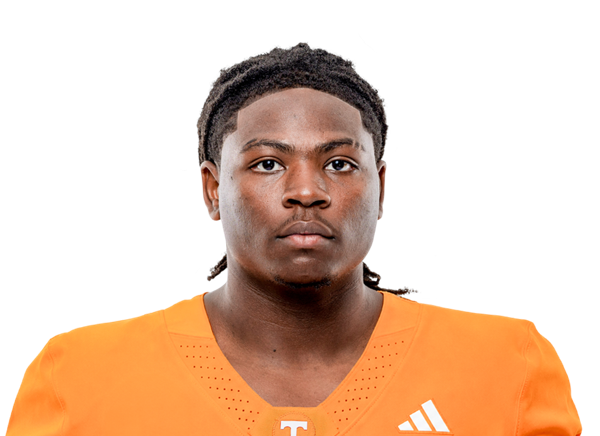
Nuk Simmons
 Tennessee
Freshman
Tennessee
Freshman
Bio
Recruiting
Scouting Report
Nic'Quayvion "Nuk" Simmons is a 6-3, 300-310 pound interior defensive lineman from Columbus (GA) Carver who signed with Tennessee in the December 2025 early period, choosing the Vols over 10 other Division I offers including Colorado and Mississippi State. A genuine late riser who played eight-man football as a freshman and sophomore, he produced one of Georgia's most disruptive senior seasons up front (54 tackles, 30 TFL, 7 sacks, 10 hurries in 11 games for a 13-0 Carver team) while coached by his cousin, former Georgia All-American Jarvis Jones. His 0.87 composite and three-star grade (247: No. 155 DL / No. 149 GA; Rivals: No. 85 DL / No. 86 GA) reflect a short evaluation window, not a low ceiling, and Rodney Garner recruited him as a developmental nose or 2-technique.
Physical Profile
Simmons has a prototypical nose-tackle frame: 6-3 with a thick, low-hipped build that has been listed anywhere from 300 to 320 pounds over the past nine months (320 on the UT signing-day packet, 300 on the 2026 roster and 247 profile). The roster number suggests the staff has already trimmed him toward a leaner playing weight, which is the right move for a player whose calling card is first-step explosion rather than pure anchor mass. His length is average for the position, so his leverage advantage comes from natural pad level and a compact torso rather than reach. Coaches consistently cite his get-off as the trait that separated him on film, and the 30 TFL total is unusual for a 300-plus pounder because it means he was winning penetration, not just holding blocks. There is no verified 40, shuttle, or camp testing on record; his athletic profile is film-derived.
Play Style
Simmons plays like a penetrating nose tackle rather than a space-eater. He fires off the ball low, gets his hands into the blocker's chest before the guard can set, and works to a gap instead of sitting in one. His TFL total shows he was frequently in the backfield on run downs, and the 10 quarterback hurries on top of 7 sacks indicate he collapses the pocket with a bull rush that leans on leverage and leg drive more than pass-rush moves. Effort is a repeated theme in evaluations, with 'hustle at the point of attack' called out specifically. He is at his best attacking one gap on early downs and using power in short-area pass rush; he is not yet a player who reads and reacts to zone schemes or stacks and sheds with technique.
Strengths
- Explosive get-off for his size: his own coaches and the Tennessee staff identified first-step quickness as the trait that drove the offer, and 30 tackles for loss in 11 games is penetration production, not clean-up production.
- Leverage and finishing power: the UT bio credits his 'combination of strength, leverage and finishing power,' and the 7 sacks plus 2 forced fumbles show he converts pressure into plays rather than stalling at the quarterback's feet.
- Production against rising competition: he earned GHSA Class A Division II Region 6 first-team honors as a junior at Chattahoochee County, then transferred up to Carver and became more disruptive, not less, on a team that finished the regular season 13-0.
- Untapped development curve: two seasons of eight-man football and only two years of true defensive-line reps mean his technique is far less refined than his production, which is the profile that tends to outperform a three-star grade under a veteran DL coach like Rodney Garner.
Areas to Improve
- Hand usage and block recognition: two years of full-field DL play left him winning largely on burst and strength; SEC guards and centers will neutralize a raw get-off with combo blocks unless he develops a consistent strike, shed, and counter plan.
- Body composition and conditioning: a 20-pound swing between signing and roster listing signals the frame was carrying soft weight; sustaining a 300-305 playing weight with better lean mass is the prerequisite for the two-gapping snaps a Tennessee nose has to eat.
- Level-of-competition adjustment: his Chattahoochee County season came in Georgia's smallest classification and even his Carver production was against 4A-level linemen, so the jump to SEC-caliber interior blockers is a larger gap than for most Power Four signees.
College Projection
Simmons walks into the deepest defensive-tackle room Tennessee has assembled under Josh Heupel: 11 interior linemen including senior Daevin Hobbs, Isaiah Campbell, Ethan Utley, Penn State transfer Xavier Gilliam, and fellow 2026 signees Dereon Albert (four-star), JJ Finch, and Darryl Rivers. As a summer enrollee who did not go through spring practice, he is a near-certain redshirt candidate in 2026, with the four-game allowance likely used on special teams or garbage-time snaps at nose. Year two is the developmental year under Garner; a rotational early-down nose role in 2027 or 2028 is a realistic target, with starting-caliber upside by his fourth season if the hand technique catches up to the burst. Recruits with his combination of frame, production, and short DL history are frequently the ones who out-play their composite; the risk case is that the get-off does not translate against SEC size and he settles into a depth role.
Best Fit
A four-down front that asks its nose to shoot gaps and disrupt rather than purely two-gap, which is exactly what Tennessee's attacking scheme under Garner does with its interior linemen. He fits programs that will invest two years of technique work before expecting snaps, and a strength staff willing to rebuild his body composition around explosion. He would be miscast as a read-and-react 3-4 nose in a passive front; his value comes from being turned loose.
Current Team
University of Tennessee