
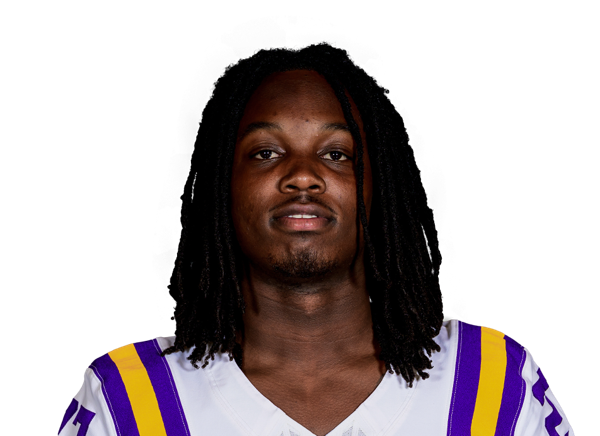
Dez Ellis
 LSU
Freshman
LSU
Freshman
Bio
Recruiting
Scouting Report
Dez (Dezyrian) Ellis is a 6-2, 189-pound positional convert — a three-year starting quarterback at Franklin Parish who has never played a snap of cornerback, and who LSU recruited to defense specifically for his length, change of direction and ball skills. He is a 4-star with a live 247Sports Composite of 92 (No. 218 national, No. 27 CB, No. 10 in Louisiana) and Rivals' No. 45 CB, and he is already on campus as a true freshman wearing No. 27, not a prospect awaiting a decision. Evaluate him as a high-ceiling tools bet with a near-total technique gap, not as a low-production corner.
Physical Profile
Prototype outside-corner frame at 6-2 with legitimate length, and the weight has already moved the right direction — 180-185 through the recruiting cycle to 189 on LSU's roster, with room for another 10-15 pounds without costing him fluidity. The athleticism is verified outside of football: a 6-4 to 6-6 high jumper who also played basketball, which speaks to the explosive lower half, body control at the catch point and vertical range that translate directly to contesting fades and 50-50 balls. Elite short-area burst and jump-cut ability show up on his carries as a runner (827 rushing yards, 10 TD as a junior). The open question is not whether the frame or the movement skills fit outside corner — they do — but whether the hips and pedal transfer, since he has never been asked to move backward against a route stem.
Play Style
On offense he is a decisive, accurate dual-threat with a live arm and the pull-it-down instincts to punish undisciplined edges; his film is full of jump cuts in space and second-reaction plays. Projected forward, the tape suggests a boundary corner who plays with vision and anticipation rather than pure mirror technique — a long-strider who will win with recovery speed and contested-catch length instead of hip flexibility early in his career. Expect the good and the bad of a converted athlete in year one: eye-catching plays on the ball where he simply out-athletes the receiver, mixed with technique busts on double moves and stems he has not yet catalogued from a defensive stance. He is not a finished cover man; he is a very good athlete learning to cover.
Strengths
- Length-plus-leverage profile at 6-2 with a 6-4/6-6 high jump background — the exact build LSU's staff targeted, and the trait that lets him win at the catch point on back-shoulder and fade throws before technique ever catches up
- Exceptional athletic testing floor and change of direction: dynamic jump cuts as a ball carrier and flashes of elite acceleration, per 247Sports' evaluation — the closing burst a boundary corner needs to recover from an early false step
- Rare processing and football IQ for a defensive convert — he ran a spread offense for three years (2,184 pass yards, 31 TD, 7 INT as a junior; ~2,500 and 29 TD as a senior; 5,744 career total yards, 73 TD, 19-6 as a starter), so he reads route concepts, formation tells and quarterback eyes from the other side of the ball with a head start most freshman corners do not have
- Proven competitive value and leadership — he lifted Franklin Parish to its first District 2-4A championship, a 10-2 season and a Division II quarterfinal, and was first-team Class 4A All-State at QB in 2024 and again as an ATH in 2025
- Ball skills and tracking developed as a receiver (his 2022 position) and a high jumper, which is why the interception production he lacks is a coaching problem, not a hands problem
Areas to Improve
- Coverage technique from zero — press hand usage, off-man pedal-and-transition, and route recognition from a backpedal are all brand-new; he has no HS corner film to grade, which is the single largest variable in the evaluation and the reason his floor is genuinely uncertain
- Physicality and run support: LSU's staff spent fall camp (defensive coordinator Blake Baker working the corners directly on Aug 8) drilling him on playing more physically. A former QB has almost no tackling, block-shedding or stalk-block-defeating reps, and SEC boundary corners are asked to set an edge
- Play strength and mass at 189 pounds — he needs to add functional weight to jam at the line and survive crack-replace duty without losing his high jumper's explosiveness
- Eye discipline in zone — QB instincts can pull a converted corner into peeking at the backfield, which is exactly how double moves and play-action shots get hit behind him
College Projection
Redshirt-track developmental year as a true freshman in 2026. LSU returns established starters in DJ Pickett and PJ Woodland, and the depth behind them is crowded with Michael Turner Jr., Ja'Keem Jackson, transfer Treylan James, Craig Walton Jr., and fellow freshmen Havon Finney and Emari Peterson — the realistic 2026 path is special teams and scout-team reps while the position change takes hold. The favorable variable is staff continuity through the coaching change: Lane Kiffin replaced Brian Kelly, but Baker (who extended the offer) and cornerbacks coach Corey Raymond (who recruited him, and who has produced nine first-team All-Americans and a Thorpe Award winner in 13 seasons in Baton Rouge) were both retained, so the people who saw the projection are the people developing it. Reasonable timeline: rotational nickel/dime and special-teams contributor by 2027, starting-caliber boundary corner in 2028-29 if the technique arrives.
NFL Outlook
247Sports' Director of Scouting Andrew Ivins carries a Day 3 projection on him, which is fair given the frame and the burst but the nonexistent coverage résumé. The upside case is materially higher than that grade — length-plus-explosion outside corners with real ball skills are the archetype that rises fastest once technique lands, and LSU pitched him a 6-3 Sauce Gardner mold at recruitment. The downside case is a career special-teamer who never develops the transition quickness to play man in the SEC. Treat him as an unusually high-variance NFL projection: Day 3 is the median, Day 2 is live if he takes the technique jump by year three.
Best Fit
He is already in close to the ideal situation. He needs a program with (a) a veteran secondary in front of him so he can be developed rather than thrown in, (b) a positional coach with a track record of building defensive backs, and (c) a scheme that lets a long corner play press-bail and quarters — where his length and closing burst matter more than 5-yard-square mirror technique, and where his quarterback-trained eyes are an asset with safety help over the top. LSU under Baker and Raymond checks all three. What would waste him is a heavy man-press-lock system that asks him to cover alone on an island in year one, or a program without the roster depth to let him sit and learn.
Player Comparison
Similar physical profile at 5'9" 190 lbs with elite athleticism and high football IQ that allowed positional versatility. Both were highly-rated Louisiana prospects who committed early to LSU based on raw talent and development potential rather than extensive film study, with coaching staffs projecting their athletic ability to translate across multiple defensive positions.
Current Team
Louisiana State University