
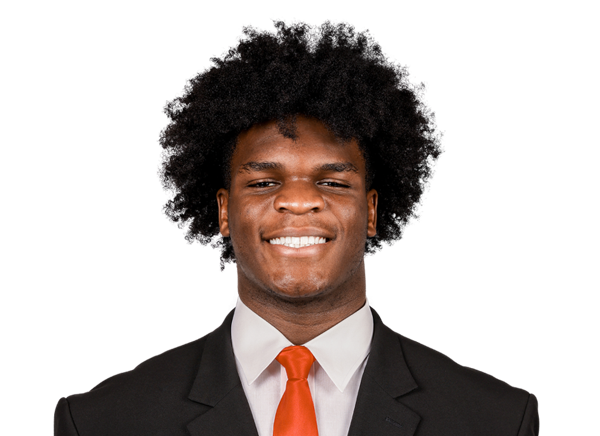
AJ Lonon Jr.
 Georgia
Freshman
Georgia
Freshman
Bio
Recruiting
Scouting Report
Anthony 'AJ' Lonon Jr. is a 6-2, 265-270 pound interior-to-edge defensive lineman from Clarke Central in Athens — a true hometown legacy whose father lettered at Georgia in 1996-97. A 247Sports Composite four-star (0.907, No. 293 nationally, No. 33 DL, No. 36 in Georgia), he chose the Bulldogs over Georgia Tech, NC State and Wake Forest from a ~27-offer board on August 2, 2025. The critical context missing from most databases: he tore his meniscus in the first week of his senior season, had surgery on September 11, 2025, and played essentially no senior football — so his junior tape (51 tackles, 13 TFL, 8 sacks) is the entire evaluation sample, and he arrives at Georgia as an early enrollee already wearing No. 38.
Physical Profile
Thickly built and low to the ground at roughly 6-1.5 to 6-2, 265-270 — a leverage frame, not a length frame. That height is below the modern SEC prototype for a five-technique and gives him shorter arms than the tackles he'll face, but it hands him a natural pad-level advantage that shows up on double teams and short-yardage downs. The rotational power is verified outside of football: he qualified for GHSA 5A sectionals in the discus (PR 142-8) and regionals in the shot put (43-5), which is direct evidence of the hip-and-torso torque that translates to a bull rush and to shocking a blocker at contact. He also played basketball, which shows in his change of direction for a 265-pounder. The frame looks close to filled out at the shoulders; the realistic athletic question is whether he can carry 285-295 at that height without losing the burst that makes him effective, because he is currently between an SEC edge weight and an SEC interior weight.
Play Style
A penetrator, not a two-gap space-eater. On junior film he's timing the snap and firing into the B-gap with pad level already under the blocker, then working laterally to the ball rather than trying to hold a gap and read. The eight sacks came mostly from interior pressure and pursuit rather than from a refined edge rush — he collapses the pocket up the middle and gets home when the quarterback climbs. Against the run he's disruptive rather than stout: he creates negative plays by getting into the backfield (13 TFL as a junior) but can get washed when he's the target of a scheme designed to move him, and he doesn't yet reliably stack-and-shed against a good down block. His best snaps are attacking, one-gap snaps on obvious passing downs and short-yardage, where his leverage and get-off are both maximized. He plays with clear motor and finishes in pursuit — the basketball background shows in how he moves in space for his build.
Strengths
- Explosive first step off the snap — the single most consistent trait on his junior film, and the direct cause of 13 TFL and 8 sacks. He wins the rep before the tackle's second kick step and converts the gap he creates into penetration rather than just running upfield.
- Elite natural leverage. At 6-2 with a squat lower half and a thrower's core (142-8 discus, 43-5 shot put), he plays under offensive linemen's pads by default. Against SEC guards that means he is very hard to move vertically on inside-zone and power.
- Gap-slipping instinct and disengagement quickness — evaluators consistently noted his ability to slip past blockers rather than stack-and-shed through them. Combined with basketball-level foot quickness, he redirects laterally without gearing down.
- Positional versatility with real evidence behind it: he was used as both an interior lineman and an edge defender in high school, which is why Georgia can develop him at defensive end under Tray Scott with a linebacker/outside conversion still on the table.
- Documented intangibles. After the meniscus surgery he stayed with the Clarke Central program in a leadership role coaching younger linemen instead of shutting down his senior year — a trait that matters more than usual for a player who will spend his first college year in a rehab-and-development track.
Areas to Improve
- Hand technique and a counter plan. His junior production came heavily off first-step quickness and slipping blocks, not off a developed rush arsenal. SEC tackles neutralize a pure get-off rusher by the second quarter; he needs a defined primary move (long-arm or club-rip suits his frame) plus a counter off it, and he needs to fight hands rather than avoid them.
- Playing strength and anchor at a fixed position. He is between weights — light for a nose or three-technique, short for a true five-technique. Georgia's strength staff has to decide whether he adds ~20 pounds to play inside or holds weight and converts to a stand-up edge. Until that's resolved, his run-defense role is limited.
- Missed developmental reps. He lost his entire senior season plus his senior offseason to a four-to-six month meniscus rehab, meaning ~18 months between meaningful competitive football and college contact. Expect technique rust and a conditioning gap relative to classmates who played 13 senior games.
- Knee durability must be re-established. The injury type has a good prognosis, but the burden is on him to prove the explosive first step — the trait his entire projection rests on — came back intact. That is a live question, not a settled one.
- Thin evaluation sample. Every ranking he holds was built on junior film. He never got the senior tape that typically separates a No. 293 prospect from a top-150 one, which is a real reason his composite sits at 0.907 rather than higher.
College Projection
A developmental redshirt candidate, not an early contributor — and that is the correct plan for him. Georgia's 2026 defensive line room is deep and he arrives off a major knee rehab having played roughly two games in the last two years, so a true-freshman burn would be a poor use of a year. Expect 2026 to be a strength-and-technique season: Tray Scott builds his hand work and decides his weight target, most likely as a defensive end in Georgia's odd fronts. Realistic timeline is rotational snaps in year two (2027), a defined role by year three, and a starting job only if he wins the leverage-plus-hands combination that Georgia's interior linemen typically develop by their redshirt sophomore year. The floor here is a quality SEC rotational lineman on special teams early; the ceiling depends almost entirely on how the weight question resolves. His in-state legacy status and the fact he's already on campus as an early enrollee are meaningful advantages — he'll have had two spring practices before his first meaningful snap.
NFL Outlook
Legitimate but distant Day 3 potential, contingent on development that hasn't happened yet. The traits scouts pay for are present in raw form — first-step explosion, verified rotational power from the throwing events, natural leverage — but at 6-2 with average length he does not have a plug-and-play NFL frame at any single position, and NFL teams are unforgiving of short interior linemen who can't anchor. His path is the one Georgia has run before: add 20-25 pounds of functional strength, become a genuine three-technique who wins with quickness and leverage, and produce for two seasons as a starter. If instead he holds weight and converts to an edge, the length becomes a hard ceiling. He is not a draftable prospect today; he is a four-year projection whose evaluation should be revisited after his redshirt sophomore season. The meniscus is not a long-term red flag on its own, but a second knee issue would be.
Best Fit
Georgia is close to the ideal landing spot, and not only for legacy reasons. He needs (1) a program that can afford to redshirt and develop him rather than play him at 265 out of necessity, (2) an elite strength staff to resolve the weight question deliberately, and (3) a defense that will let him attack one gap rather than asking him to two-gap and read, which would neutralize his only elite trait. Georgia's multiple front checks all three — Kirby Smart's staff has repeatedly turned sub-top-200 in-state linemen into SEC starters and NFL picks via exactly this timeline. Scheme-wise he's a fit as an attacking three-technique in a four-man front, or as a heavy end in an odd front on passing downs. He is a poor fit anywhere that needs immediate snaps from its 2026 signees, and a poor fit in a pure two-gap read-and-react system. Staying in Athens also keeps him with the medical staff that managed his rehab from the start — a non-trivial factor given the injury.
Current Team
University of Georgia