
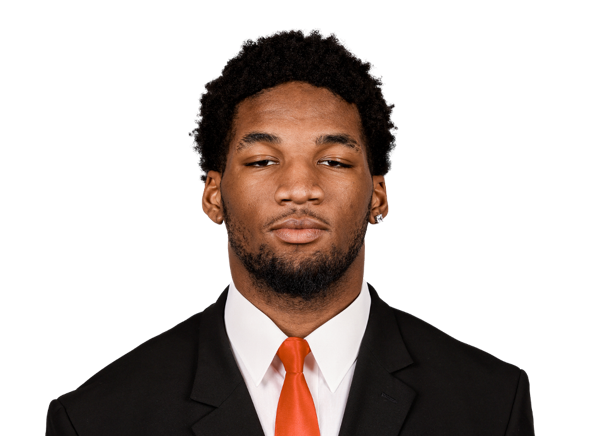
PJ Dean
 Georgia
Freshman
Georgia
Freshman
Bio
Recruiting
Scouting Report
Pierre 'PJ' Dean Jr. is a 6-foot-3.5, 260-pound defensive lineman from West Forsyth (Clemmons, NC) who signed with Georgia in December 2025 and is now on campus as a true freshman. He is a genuine high-four-star — No. 98 nationally, No. 11 DL and No. 6 in North Carolina in the 247Sports Composite — who arrives with an unusual profile: a two-way, All-State-caliber offensive tackle who converted to the defensive line in the spring of 2025 and immediately posted 18 tackles for loss and six sacks as a senior. He is the younger brother of former Georgia center Jared Wilson, a 2025 third-round pick of the Patriots, and chose the Bulldogs over Ohio State and a hard late South Carolina push.
Physical Profile
Dean checks in at 6-3.5 and 260 with big-framed structure, large hands and above-average length for the interior — the kind of build that projects to carry 285-295 without losing burst. The critical data point is trajectory, not the static number: he dropped more than 50 pounds over his final two high school years, converting a mass-first offensive tackle body into a mobile defensive frame, and the improvement showed up in verified combine testing rather than just on film. That leaves him in the rare position of having significant bulking capacity remaining on a frame that has already proven it can add and shed weight without athletic cost. The length and hand size are the traits that make him scheme-flexible along the front; the current playing weight is the one thing that is clearly not yet SEC-ready for interior snaps.
Play Style
Dean plays with an offensive lineman's understanding of blocking angles turned against the people who use them. He wins the snap with a quick first step, gets his pads under the blocker's, and drives through the man's frame with sustained leg churn rather than trying to beat him with a finesse move — a bull-rush-first profile that produces pocket collapse and a lot of tackles for loss on running plays that never get to the second level. When the rush stalls, he keeps his eyes on the quarterback and gets his hands up, which is where the eight pass breakups come from. On defensive tape he shows the same relentless, high-motor demeanor scouts noted on his offensive film, and the interception returned for a score is evidence of awareness rather than just athletic accident. What he does not yet show is a rush that changes after contact — the plan is currently power, then more power.
Strengths
- Elite leverage and leg drive for the position — two full varsity seasons playing left tackle taught him to win the pad-level battle first, and he applies it in reverse on defense with a low, sustained drive that collapses the pocket rather than merely occupying it.
- Explosive get-off and penetration ability that converted immediately: 18 tackles for loss on 40 total stops as a senior is a 45 percent disruption rate, meaning nearly half his tackles came in the opponent's backfield — that is production, not accumulation.
- Exceptional hand size and above-average length, which shows up in an unusual secondary stat line for a defensive lineman — eight pass breakups plus an interception returned for a touchdown, all from batting and rerouting throws at the line of scrimmage.
- Positional versatility with real reps behind it: First-Team All-State offensive line as a junior and First-Team defense on the HSOT 336 All-Region team, with snaps at left tackle and multiple defensive front spots.
- Tone-setting field demeanor noted consistently in evaluations, backed by a 10-3 senior team and a legacy pedigree — his brother started at center for Georgia and was drafted in the third round, so he knows exactly what the program's standard looks like.
Areas to Improve
- Pass-rush plan and counter development. He has roughly one season of full-time defensive line reps, and the senior tape wins on get-off, leverage and effort rather than on a sequenced rush. He needs a defined primary move and at least one counter off it before SEC tackles stop being beaten by first-step quickness alone.
- Playing weight and anchor for interior work. At 260 he can be reduced by double teams against SEC guard-center combinations; Georgia will likely want him in the 285-295 range, and the challenge is adding that mass without giving back the athleticism he spent two years buying with a 50-pound cut.
- Run-defense discipline within a gap structure. Two-way high school players get coached to make plays, not to hold a gap. His pursuit-and-penetrate instincts will need to be channeled into two-gap responsibility and edge-setting technique, which is exactly the transition Georgia's staff drills hardest on freshman linemen.
- Hand usage as a defender. His hands are a genuine asset — large and strong from tackle play — but blocking hands and shed hands are different skills. Learning to strike, extend and disengage rather than absorb is the single biggest technical carryover problem from the position switch.
College Projection
Realistic timeline is a redshirt or minimal-snap true freshman season in 2026, spent almost entirely in the weight room and on hand technique. Georgia's defensive line room under Tray Scott is one of the deepest in the country and rarely plays freshman linemen meaningful snaps; the developmental path for a converted, still-lean 260-pounder is to add functional mass through year one, break into the rotation as a redshirt freshman or true sophomore in 2027-28, and compete for starting snaps at strongside end or three-technique by 2028. His floor is a quality SEC rotational lineman; the ceiling is multi-year starter, and the pace of that arc depends almost entirely on how quickly he adds weight and builds a pass-rush repertoire. He is also a legitimate emergency-depth answer on the offensive line given his All-State tackle background, though Georgia recruited him to play defense and moving him back would waste the athletic transformation.
NFL Outlook
The traits profile is draftable — length, hand size, verified athletic improvement, and a frame with room for 30 more pounds are the exact boxes NFL area scouts check on interior linemen. He also carries the credibility of a bloodline that already produced a third-round pick out of the same program. The projection is genuinely uncertain because he is being evaluated on roughly one year of defensive line film: if the pass-rush plan develops and he anchors at 290, he profiles as a Day 2 interior defender in the 2029-2030 range; if he remains a power-only rusher, he is a late-round or priority-free-agent rotational body. Development curve matters more here than for almost any other player in this class, because the current tape is closer to his floor than his ceiling.
Best Fit
Georgia is close to the ideal landing spot and not just for legacy reasons. He needs a program with a five-star strength and development infrastructure, a defensive line room deep enough to let him sit for two years without pressure to play at 260, and a defensive line coach with a track record of building converted athletes into interior starters — Georgia checks all three. Schematically he fits an attacking, one-gap four-man front where his get-off and leverage are assets and he is asked to penetrate rather than two-gap and read; a base 4-3 or a multiple front using him at strongside end early and kicking him inside to three-technique as he fills out is the optimal usage. He would be poorly served by a program needing immediate snaps from a freshman or by a pure two-gap 3-4 nose scheme, which would demand the mass he does not yet have while neutralizing the quickness that is currently his best trait.
Player Comparison
Floyd shared a similar physical profile at 6'3" 244 lbs with elite athleticism and was also a highly-rated prospect who committed to Georgia. Like Dean, Floyd had the versatility to play multiple positions along the defensive front and possessed the combination of size, speed, and football IQ that made him a consistent impact player at the college level before translating to NFL success.
Current Team
University of Georgia