
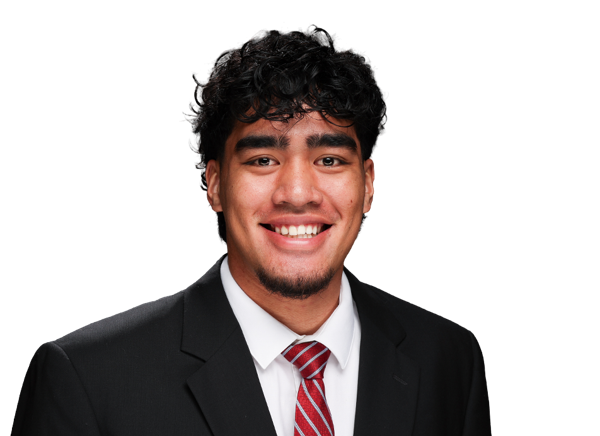
Tayden-Evan Kaawa
 Alabama
Freshman
Alabama
Freshman
Bio
Recruiting
Scouting Report
Tayden-Evan Kaawa is a 6-5, 240-pound pocket passer from Moloka'i, Hawaii who transferred to Orem (UT) and became one of the West's most productive two-year starters: 2,890 yards/28 TD/9 INT as a junior, then 2,585 yards/35 TD plus a 42-7 Utah 5A state title win as a senior. Split-service prospect — a 4-star and top-15 QB on Rivals, a high-3-star on 247Sports (composite 0.8822) — he is now an early-enrolled true freshman at Alabama, sitting behind Austin Mack and Keelon Russell alongside fellow signee Jett Thomalla.
Physical Profile
Kaawa's frame is his calling card. At 6-5/238-240 he already carries a college-ready lower half and a thick trunk; 247Sports' Greg Biggins compares the build directly to DJ Uiagalelei. The size gives him a clean sightline over the line, a durable pocket presence, and the leverage to drive throws 50+ yards without full lower-body engagement. For his mass he is a functional athlete rather than a stiff one — he logged 59 carries for 318 yards and 4 TDs on zone-read keepers as a junior and roughly 290 rushing yards as a senior — but he is a straight-line mover, not a creator. The baseball background shows up in his throwing base and arm slot repeatability. Weight management (staying near 235–240, not drifting to 250+) will matter for pocket mobility.
Play Style
A big-bodied, rhythm-and-drive thrower. Kaawa sits in the pocket, sees over the rush, and attacks intermediate and vertical windows with velocity — deep outs, seams and post routes are where he separates. Orem used him as a distributor on RPO and quick-game concepts with a heavy dose of designed keepers near the goal line, where his mass made him a short-yardage weapon. When the play breaks down he extends by climbing or sliding rather than scrambling wide, and he keeps his eyes downfield. His tendency is to trust the arm over the progression; the best version of his film is when the concept defines the throw pre-snap, and the worst is when he waits on a covered first read and forces it late.
Strengths
- Arm strength and downfield drive: consistently pushes the ball to the far hash and vertical routes with velocity; Biggins highlights his 'ability to drive the ball down the field' as the defining trait.
- Production against real competition: 63 total TDs over two seasons at Orem, 63–64% completion each year, and a 35-TD senior campaign capped by a state title — he was the reason the offense worked, not a passenger.
- Size-adjusted mobility: comfortable on designed zone-read keepers and able to extend plays when the pocket breaks down, which a 240-pound passer often cannot do.
- Shotgun-spread comfort and rhythm throwing: operates almost exclusively from the gun, throws with timing on RPO glance/slant concepts and can pick apart a defense when reads are pre-snap defined.
- Competitive makeup: chose a crowded Alabama room over BYU and Boise State, saying he wanted the competition; already an early enrollee with A-Day reps.
Areas to Improve
- Processing speed and post-snap reads — the consensus knock. 247Sports notes he 'needs to continue to progress in his ability to make quick reads, process the game and get the ball out on time.' He holds the ball and trusts the arm when the first read is covered.
- Footwork and lower-body mechanics under pressure: tends to throw from an upright, arm-dominant base when the pocket gets muddy, which flattens accuracy on intermediate throws.
- Under-center and play-action work: nearly all HS snaps were shotgun; Alabama's Grubb/Sheridan offense will ask for more pro-style footwork and boot action.
- Turnover discipline on tight-window throws: 9 INTs as a junior on 294 attempts is a manageable but real number that came from forcing balls late in the down.
College Projection
Developmental, multi-year investment. He is a true freshman in 2026 behind Mack and Russell, competing with Thomalla (rated slightly higher) and John Gazzaniga for the QB3/QB4 reps; Alabama's own preview says he 'is not expected to compete' for the job this year. Expect a redshirt in 2026 with scout-team reps and a mechanical rebuild under Nick Sheridan. Realistic path: backup by 2027–28, pushing for the starting job as a redshirt sophomore or junior if Russell leaves early — or a transfer to a Mountain West/Big 12 program where he starts sooner. His toolset (size, arm, production) is starter-caliber; the timeline is set by processing growth, not talent.
Best Fit
A pro-style, play-action-heavy scheme with a run game that lets him throw off play fakes and attack the intermediate-deep areas — exactly what Ryan Grubb's system at Alabama does. He would be miscast in a tempo-based, get-it-out-in-1.8-seconds air raid, which stresses his weakest trait. Programs like BYU, Boise State or a Big 12 pro-spread that use his size in the QB run game near the goal line while building from a defined-read passing tree would maximize him fastest if the Alabama room does not open up.
Player Comparison
Both prospects share similar physical builds at 6'4" 235+ with elite program interest despite limited early film. Lotulelei was also a highly-rated Polynesian prospect who developed into a dominant defensive lineman, showcasing the natural strength and motor that Alabama likely sees in this Hawaiian recruit.
Current Team
University of Alabama